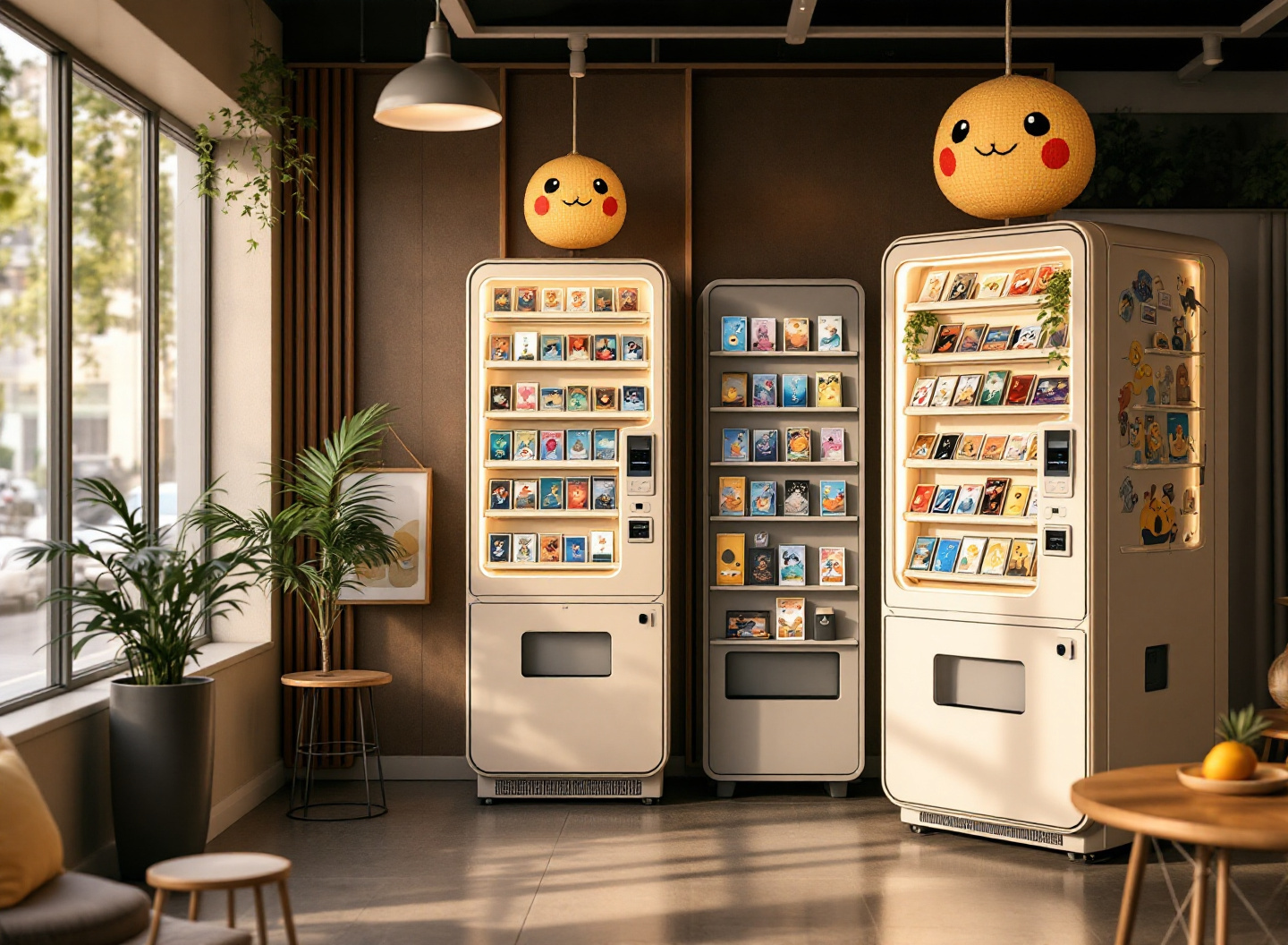
Yes, Pokemon card vending machines are legit when they are operated by authorized retail partners or reputable kiosk operators that stock sealed product and publish clear support and return policies. The machines themselves are ordinary automated retail hardware, but scam signals appear when sellers make impossible claims about guaranteed pulls, unverifiable sourcing or no-receipt cash-only sales. According to Pokemon.com, the official Pokemon Vending Machine program places machines in select retail locations across the US, which gives buyers a real baseline for what authorized automated retail looks like.
How Do Pokemon Vending Machines Work and What Are They?
A Pokemon vending machine is an automated retail kiosk that dispenses sealed Pokemon Trading Card Game products, typically booster packs, Elite Trainer Boxes or promo bundles, after a cashless payment is authorized.
Most units use a touchscreen catalog, a payment terminal and a motorized spiral or belt dispensing system. The machine holds inventory in locked compartments, logs each transaction and sends restock alerts to an operator dashboard. Buyers select a product, pay and receive a sealed item from the dispensing slot. Because the product is sealed at the factory, the machine is effectively a retail shelf with automation rather than a gambling device.
KioskX builds automated retail hardware and software for card and collectible sellers at kiosk-x.ai. Its published product information describes kiosk management features such as inventory monitoring, remote diagnostics and transaction reporting, which are the operational backbone a legitimate seller needs. The Pro Max configuration is listed as a preorder, not a delivered product, so buyers should treat delivery timelines as pending until confirmed by the vendor.
Key Takeaway: A real Pokemon vending machine is sealed-product retail with payment authorization and inventory tracking, not a mystery box or a pull-rate game.
Are Pokemon Vending Machines Real? Where Are They Located?
Pokemon vending machines are real and are located primarily inside large US retail chains, grocery stores and select shopping centers where the official program or an authorized operator has placed them.
The official program is documented by Pokemon.com, which lists participating retail partners and notes that availability varies by location. Independent operators also place trading card kiosks in comic shops, card stores and convention venues. Location matters for legitimacy: a machine inside a staffed national retailer is easier to verify than a standalone unit in an unstaffed hallway.
If you want to know whether a machine is coming near you, check the retailer's store locator or ask the store's customer service desk. Operators usually announce new placements through their own channels before the machine goes live.
Key Takeaway: Legit machines live in verifiable, staffed retail environments and placement announcements come from the operator or the host store.
Are the Pokemon Cards from Vending Machine Packs Fake?
Pokemon cards from vending machine packs are not fake by default, because authorized machines stock factory-sealed product from normal distribution channels, but counterfeit risk rises with unverified operators.
Fake cards usually enter the market through online resellers and unlicensed pop-up sellers, not through machines that dispense sealed retail packaging. A sealed booster pack from a legitimate machine carries the same packaging integrity as one from a store shelf. Buyers should inspect the seal, check the crimp and compare the product against known print runs if anything looks off.
Reddit threads asking "are the pokemon cards from vending machine packs fake" often describe damaged packaging or resealed product from third-party marketplaces rather than from kiosks. The practical rule is to buy from machines hosted by recognizable retailers and to keep the receipt.
Key Takeaway: Sealed product from an authorized machine is normal retail inventory; counterfeit concerns apply mainly to unverified sellers.
Pokemon Vending Machines Are Scams r/pokemontcg: What Reddit Gets Right and Wrong
The claim that "pokemon vending machines are scams r pokemontcg" mixes a valid warning about shady operators with an unfair generalization about the entire category.
Reddit users are right that some operators misrepresent pull rates, hide return policies or vanish after a machine breaks. They are wrong when they imply every kiosk is a scam, because national retailers and established card shops run legitimate machines every day. The useful signal in those threads is the pattern of complaints: no receipt, no support contact, no visible operator name and no restock history.
When you read a scam allegation, check whether the poster names the operator and the host store. Specific, verifiable complaints are worth heeding. Vague claims that all machines are rigged are not evidence.
Key Takeaway: Reddit skepticism is a useful checklist for red flags, not a verdict on the whole vending category.
The Legal Truth About Trading Card Vending Machine Operation in the US
The legal truth about trading card vending machine operation in the US is that the business is regulated like other retail vending, with local permits, sales tax collection and consumer protection rules applying to the operator.
Operators typically need a state sales tax permit, compliance with local business licensing and adherence to FTC rules against deceptive advertising. Age-restricted products such as vape hardware require ID verification and are regulated separately from trading cards. Trading card machines do not sell age-restricted goods, but they must still honor refund and dispute rules and disclose the operator's identity.
Buyers should know that a machine sale is still a retail sale, so normal consumer protections apply. If a machine takes payment and dispenses nothing, the operator owes a remedy.
Key Takeaway: Legit operators carry permits, collect sales tax and publish a support path, which is exactly what regulators expect.
Pokemon Automated Retail Vending Machine FAQ: Restocks, Cameras, Returns and Reporting Issues
The pok mon automated retail vending machine FAQ comes down to four operational questions: restock timing, camera use, return policy and issue reporting.
Restocks depend on the operator's inventory cycle and many kiosk management dashboards send low-stock alerts automatically. Cameras are used for loss prevention and transaction verification, not for tracking individual buyers beyond the sale. Return policies vary, but reputable operators publish a support email and a receipt-based process. If a machine fails, report the issue to the host store's service desk and to the operator contact printed on the machine.
KioskX publishes operational guidance on its blog for sellers managing automated retail. Buyers and retailers should confirm return terms before purchase, because policies differ by operator.
Key Takeaway: Restocks, cameras, returns and issue reporting all follow the operator's published policy, so find that policy before you buy.
Are Pokemon Vending Machines Worth It for Buyers and Retailers?
Pokemon vending machines are worth it for buyers who value sealed product availability outside staffed hours and for retailers who want incremental card sales without adding counter labor.
For buyers, the value is convenience and sealed-product confidence. For retailers, the value is a small footprint, remote inventory visibility and the ability to capture collectible demand during peak hours. The tradeoff is that margins on sealed product are thin and machine uptime depends on maintenance discipline.
KioskX positions its kiosks for sellers who already understand collectible retail. No vendor can promise income and any operator promising guaranteed returns should be treated as a red flag. Buyers should also note that Pro Max is a preorder configuration, not a shipped product today.
Key Takeaway: Worth is a function of sealed-product demand and maintenance discipline, not a promised return.
Can You Make Money with Vending Machines? Practical US Examples
You can make money with vending machines when the machine's monthly gross profit exceeds its rent, payment processing, restock and service costs and that math is the only honest answer.
Practical US examples include a comic shop hosting a card kiosk near the register, a mall operator placing a kiosk in a high-traffic corridor and a card store adding a second unit at a convention venue. Each example succeeds or fails on foot traffic, product mix and uptime. Operators typically track units sold per day, restock frequency and shrink.
Use a simple model: monthly sales minus cost of goods, rent share, processing fees and maintenance. If the remainder is positive after realistic assumptions, the unit may be viable. No source can promise a specific return for your location.
Key Takeaway: Profitability is a local math problem built on traffic, margin and uptime, not a product promise.
Am I Allowed to Put a Vending Machine Anywhere? Rules, Power and Placement
You are not allowed to place a vending machine anywhere you like, because placement requires the property owner's permission, compliance with local zoning and a reliable power and network connection.
Host stores usually require a written agreement covering rent, insurance and liability. Some municipalities restrict vending in public rights of way. Power draw, network access and physical security all need to be confirmed before installation. For any placement question, confirm host approval, local permits and utility access in writing.
Operators should also plan for restocking routes and service access. A machine that blocks an aisle or lacks a network signal will underperform regardless of product demand.
Key Takeaway: Placement is a permission and infrastructure question first and a product question second.
Quick Reference Table: Legit Machine vs Scam Signals
Frequently Asked Questions
Are these Pokemon vending machines a scam?
No, not as a category. Authorized retail machines and reputable operator kiosks stock sealed product and publish support policies. Treat guaranteed pulls, no-receipt cash sales and missing operator contact info as scam signals.
I tested a Pokemon card vending machine. Is it a scam?
A single test cannot prove a scam. Check for a receipt, a printed operator name and a visible return policy. If the machine dispensed sealed product with a receipt, that is normal retail behavior, not a scam.
What if the product I want is out of stock?
Ask the host store's service desk or contact the operator listed on the machine. Restock timing depends on the operator's inventory cycle and many kiosk dashboards send automatic low-stock alerts.
I am currently experiencing an issue at a vending machine. How can I report it?
Report it to the host store's service desk and to the operator contact printed on the machine. Keep your receipt and a photo of the machine's identification panel, then follow the operator's published dispute process.
Can I buy a vending machine or have one placed at my store?
Yes, retailers can inquire with kiosk vendors such as KioskX at kiosk-x.ai about purchasing a machine or hosting a placement. Ask for written terms on rent, insurance, delivery timelines and support and note that the Pro Max configuration is currently a preorder.
Do vape vending machines ID and can you sell vapes in a vending machine?
Vape products are age-restricted and are regulated separately from trading cards. Any vape vending machine must verify age and comply with federal state and local rules, so buyers and operators should confirm applicable law before selling or hosting them.
Conclusion: How to Tell Legit Pokemon Card Vending Machines from Scams
Legit Pokemon card vending machines are verifiable retail units that stock sealed product, issue receipts and publish a support path. Scams are identified by missing operator identity, guaranteed payout claims and no return policy. Use the table above as a checklist, buy from staffed retail locations and keep your receipts.
If you are a retailer exploring automated retail, review KioskX's published hardware and management features at kiosk-x.ai and read the operational guidance on the KioskX blog. Confirm written terms before committing and treat any income promise as a warning sign.
Key Takeaway: Verify the operator, the seal, the receipt and the return policy and you can separate a real kiosk from a scam.
Author: Jordan Ellis, Retail Automation Writer Published: November 16, 2026
Draft note: this article is a noindex draft until the existing blog approval gate publishes it.